
TREBB RELEASES AUGUST MARKET STATS
The number of homes available for sale in August 2026 was down
noticeably compared to last year in the Greater Toronto Area (GTA). Following
this trend, home sales also edged lower, as the number of transactions was
arguably limited by less choice in some neighbourhoods. Less choice and more
competition between buyers could ultimately result in renewed price growth in
the months ahead.
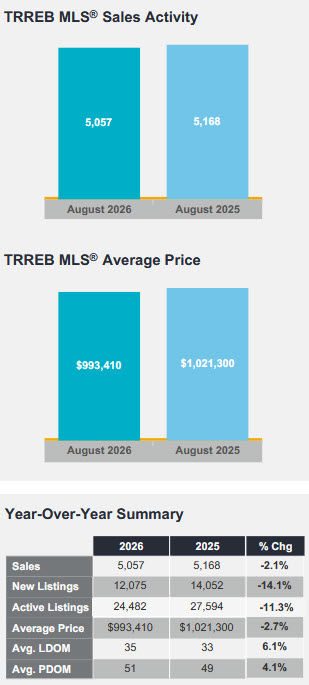
GTA REALTORS® reported 5,057 home sales through TRREB’s MLS®
System in August 2026 – down 2.1 per cent compared to August 2025. New listings
entered into the MLS® System amounted to 12,075 – down by 14.1 per cent
year-over-year.
On a seasonally adjusted basis, August 2026 home sales were down
slightly month-over-month compared to July 2026, while new listings were up.
“If inventory tightens and home prices begin to rise, some buyers
may face a trade-off between waiting for greater economic certainty and
purchasing before prices move higher. At the same time, improving market
conditions for sellers could bring more listings to market, providing buyers
with additional choice,” said Toronto Regional Real Estate Board (TRREB)
President Daniel Steinfeld.
The MLS® Home Price Index (MLS® HPI) Composite benchmark was down
by 4.5 per cent year-over-year in August 2026. The average selling price, at
$993,410, was down by 2.7 per cent.
On a month-over-month seasonally adjusted basis, MLS® HPI
Composite was essentially flat compared to July 2026. The average selling price
edged up over the previous month.
“Ownership housing in the GTA has remained relatively affordable
over the past year, with average prices dipping and mortgage rates remaining
somewhat flat. Recent news on the overall economy and job creation has been
positive. The main hold-back for many households has been concerns around trade
with the United States and the potential for higher inflation and borrowing
costs in the future,” said TRREB’s Chief Information Officer Jason Mercer.
“A more balanced resale market is a positive development, but it does not address Ontario’s ongoing housing supply and affordability challenges. Governments should take advantage of this opportunity to eliminate barriers to attainable housing, including restrictive zoning policies, high taxes and development charges, and lengthy approval processes. Municipalities, in particular, play a significant role in determining how much housing is built, how quickly projects move forward, and the overall cost of delivering homes,” said TRREB CEO John DiMichele.
What's next?
P.S. Download our FREE Home Buyer's Guide OR our FREE Home Seller's Guide
P.S.S. Book a FREE Home Buyer Consultation OR a FREE Home Seller Consultation